Court Branding

How the brand comes to life in physical spaces – from venue banners to outdoor facades.
01
First: what does the space explain?
Every surface decision starts with one question: does the space explain the sender here, or only the sport? That determines whether the logo may be omitted. The rules invert between levels.
| Level | Situation | The space explains | Consequence |
|---|---|---|---|
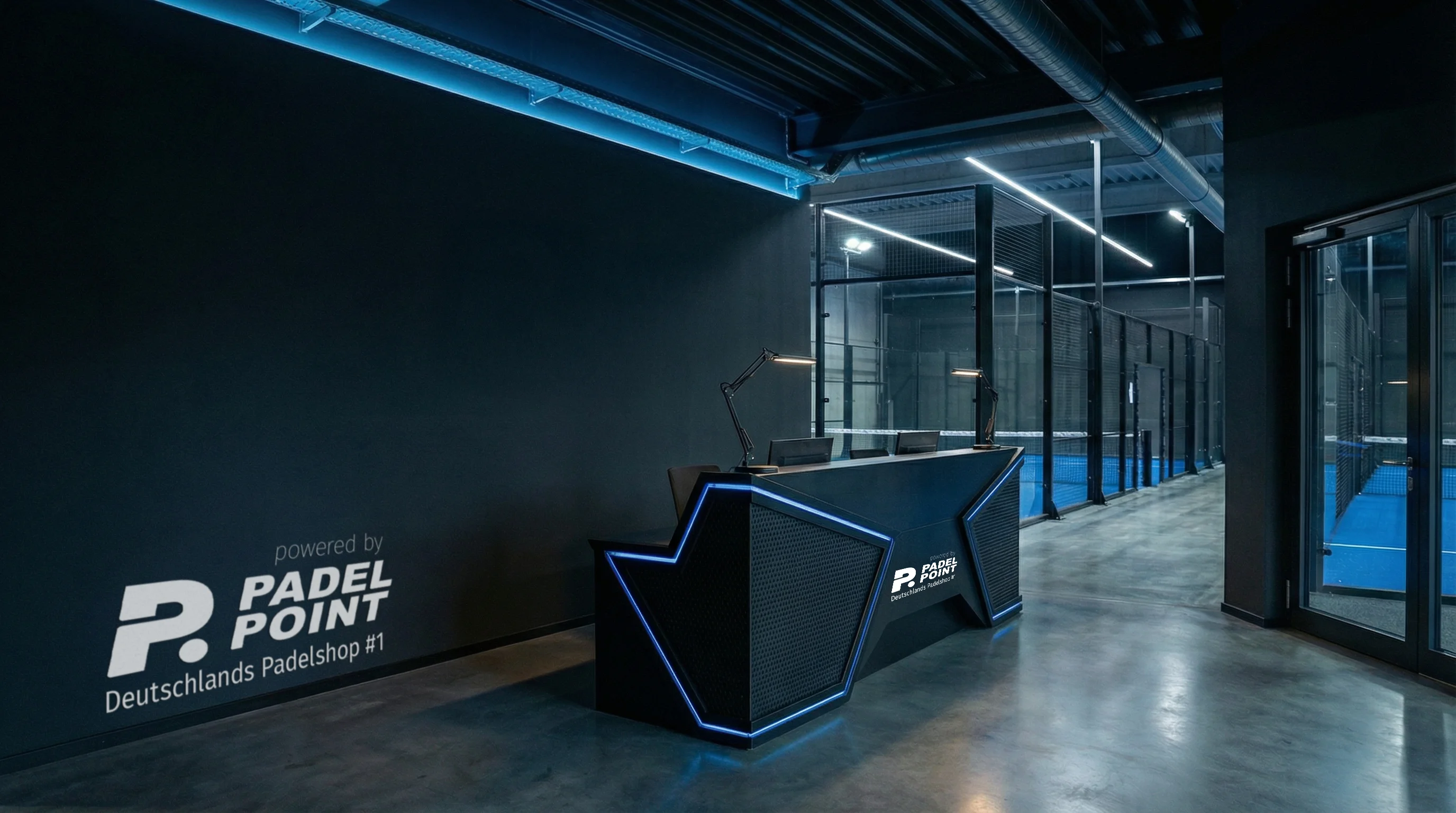
| 1 | Own location, permanent | The sender. Whoever stands here knows whose space this is. | The logo may be omitted, the claim works as a statement, glass carries marks only. |
| 2 | External venue, permanent | Category only. Padel yes, Padel-Point no. | Every surface stands alone: sender, message and reference belong together on one surface. |
| 3 | External site, temporary | Nothing. Instead several carriers share one field of view. | The appearance is one layout across several carriers. Placement becomes part of the rule. |
| 4 | Carrier without a space (apparel, bags) | Nothing. A single field of view. | The category line replaces the claim. |
02
The nine zones on court
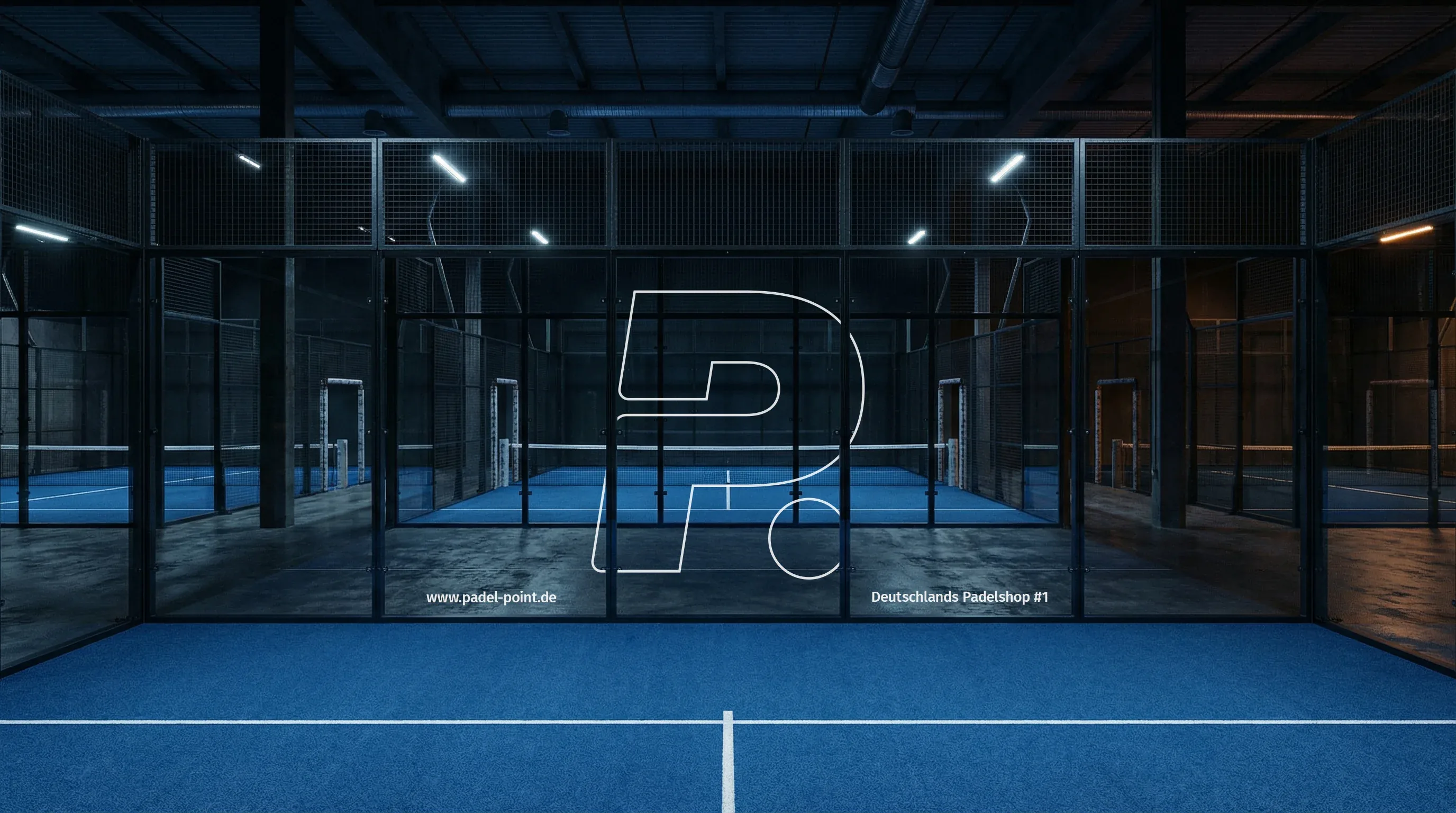
A padel court has nine distinct branding surfaces. Each has its own rules for logo variant, text and material. Applies to level 1, the own location.
| Zone | Surface | Logo | Text | Size |
|---|---|---|---|---|
| A | Rear glass | Wordmark or monogram, white, vinyl cut, outside | No text | 2000 × 400 mm |
| B | Side glass | Monogram outline, white | No text | Ø 300 mm |
| C | Upper glass | Leave clear | No text | – |
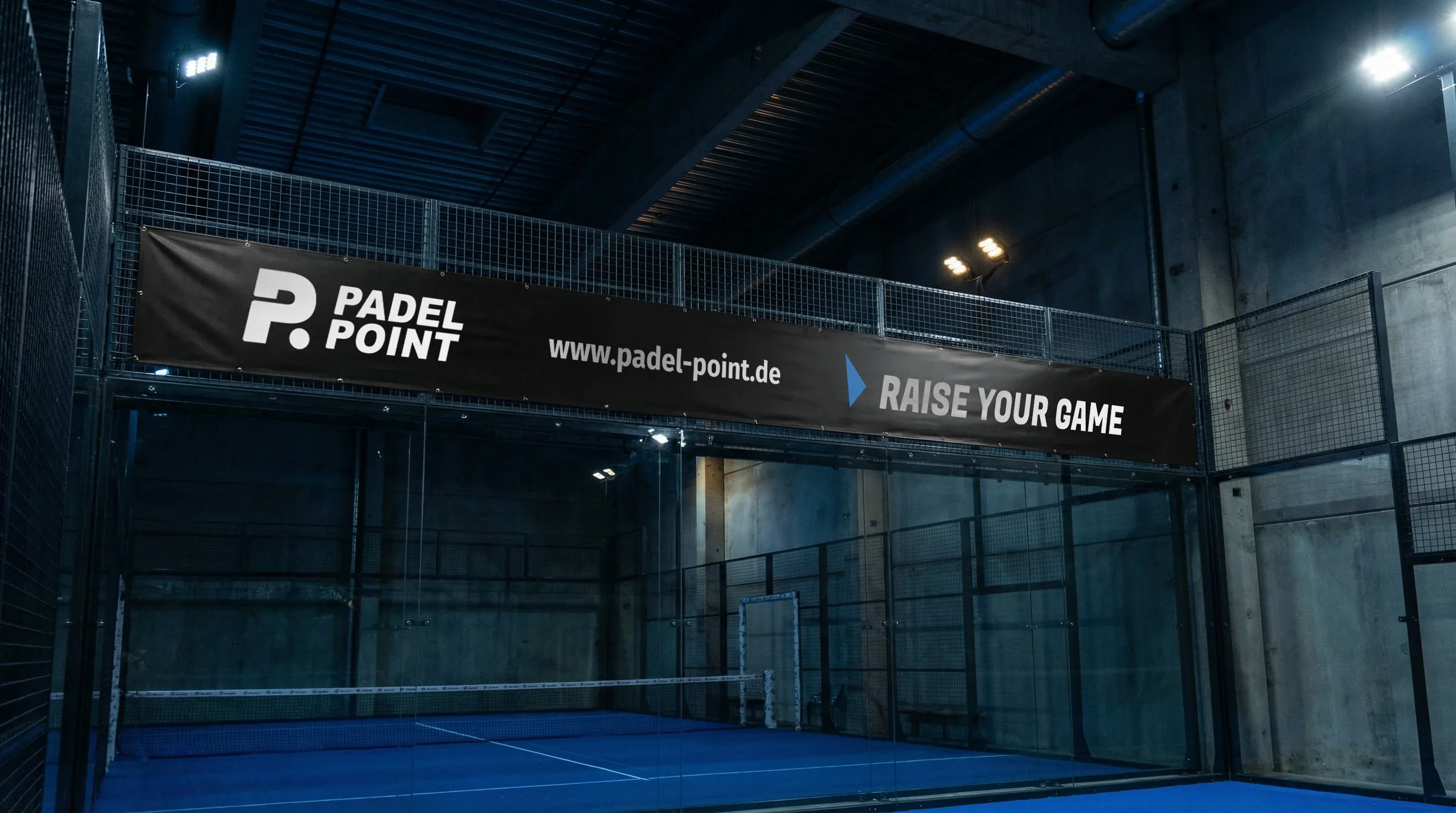
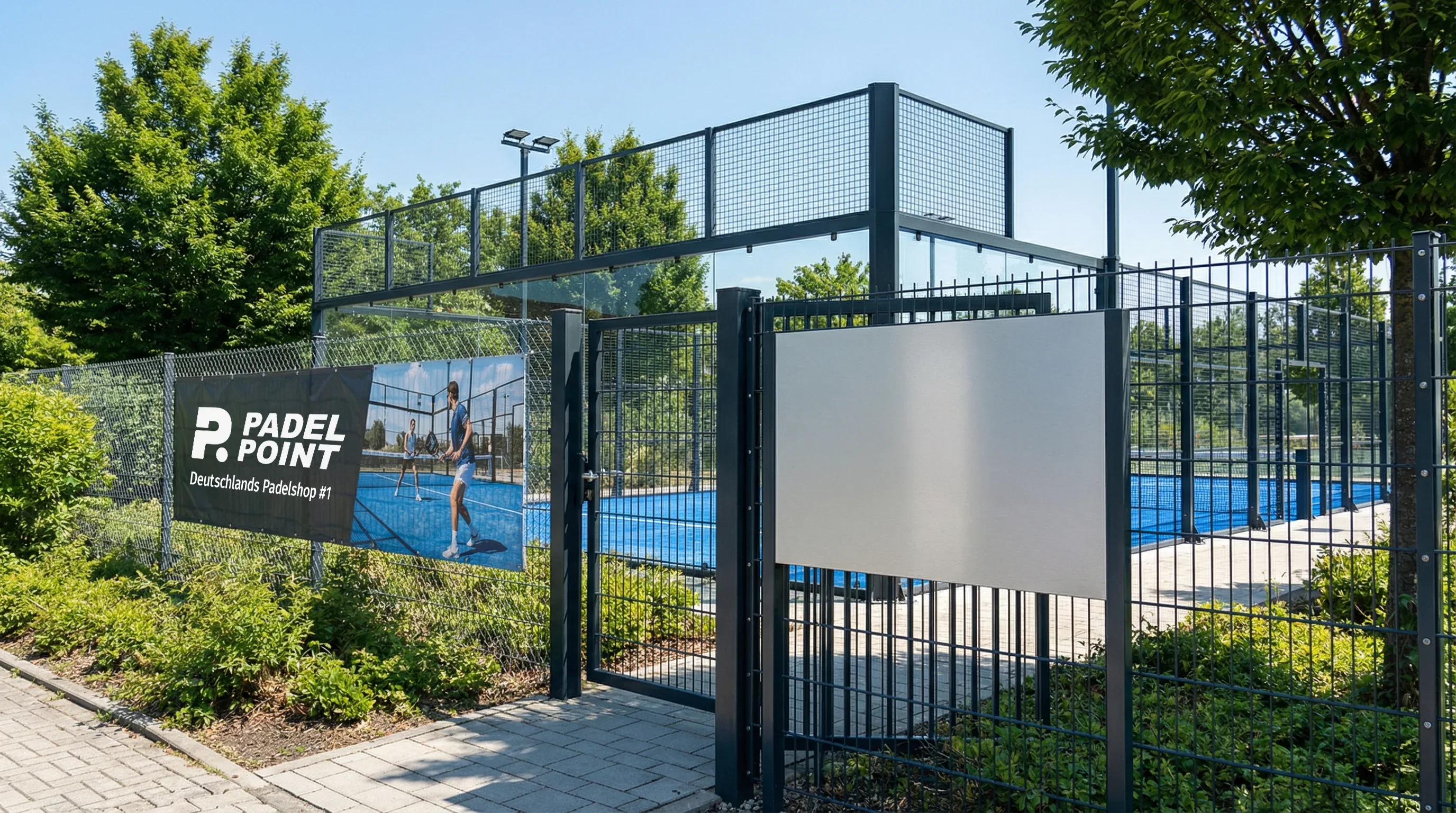
| D | Cage grid banner | Horizontal wordmark, left | Claim to its right | 1950 × 950 mm |
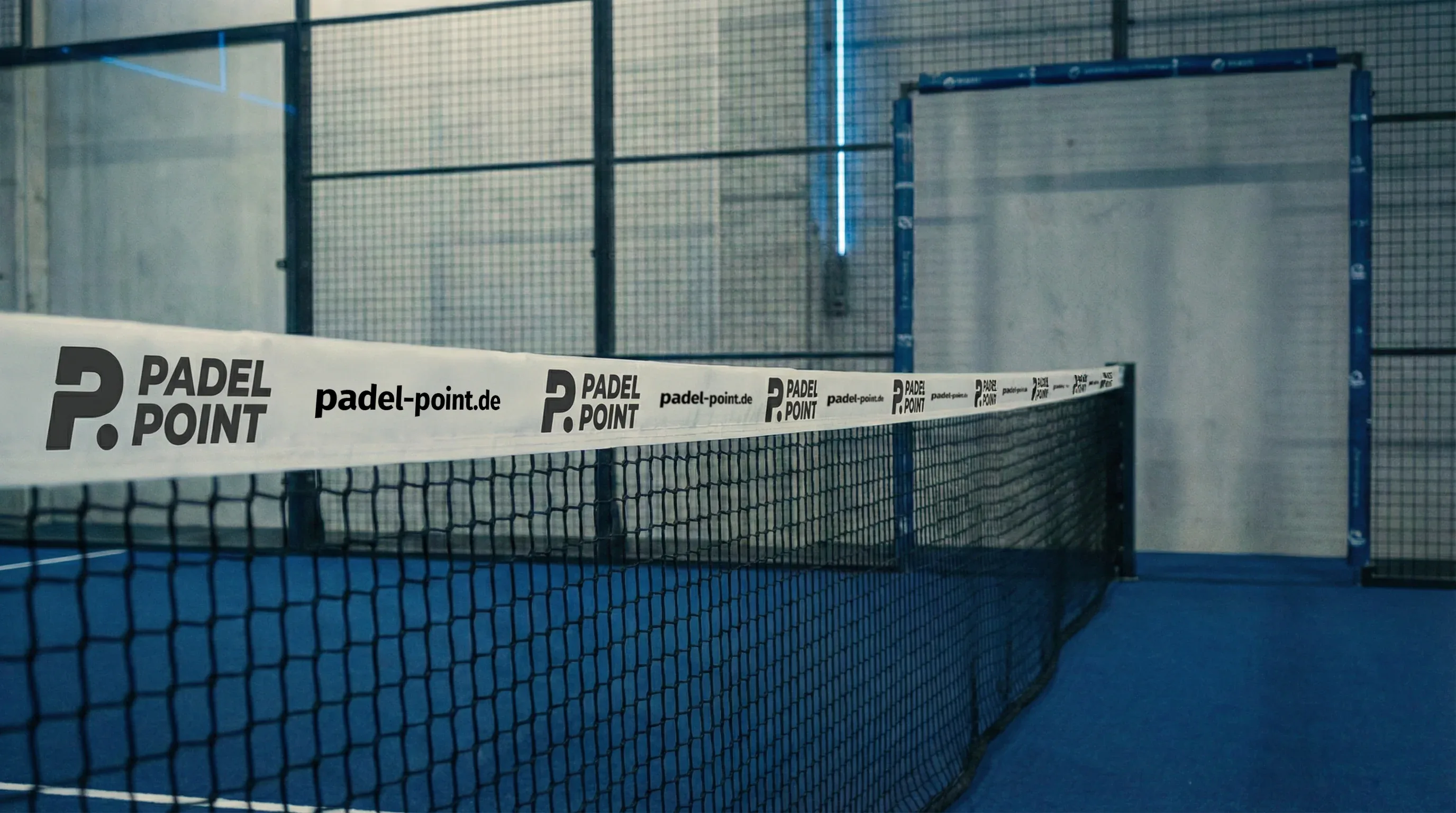
| E | Net band | Small wordmark, white on PP blue | No text | max. 9 cm high |
| F | Net post | Monogram outline, white | No text, too little room | – |
| G | Entrance, impact guard | Monogram, white on dark grey | No text | – |
| H | Floor | No logo | Claim only temporarily, at events | – |
| I | Wind screen | Wordmark plus hero visual | Outdoor only | Mesh, by the metre |
03
Which logo variant goes where
The variant follows the context, not taste.
The wordmark is the sender
Wherever the brand is not yet self-evident: rear glass, entrance, cage banner, every portable carrier.
The monogram is the anchor
Where the brand is already recognisable from context: side glass, net posts, impact guards.
No logo where the text leads
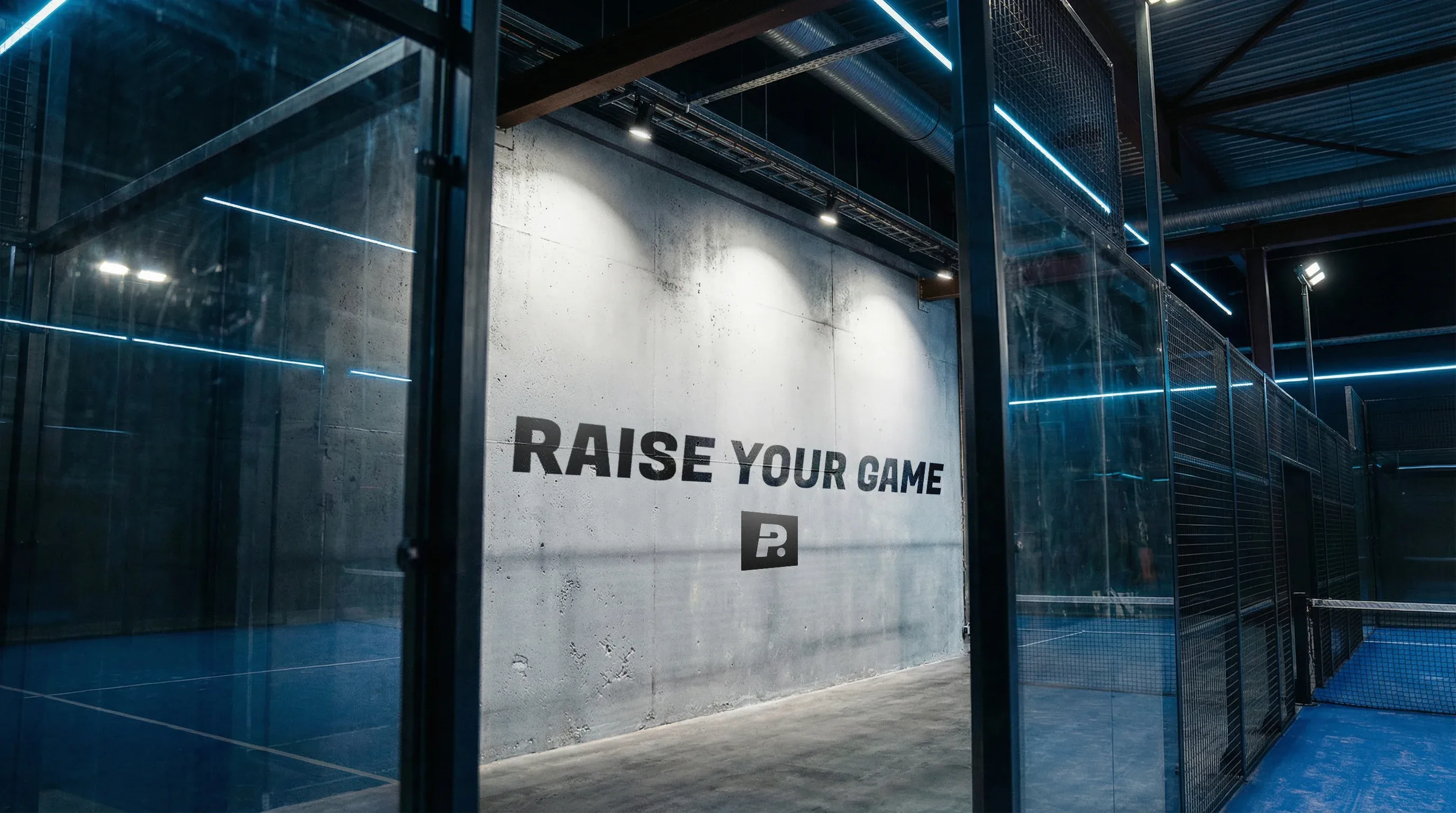
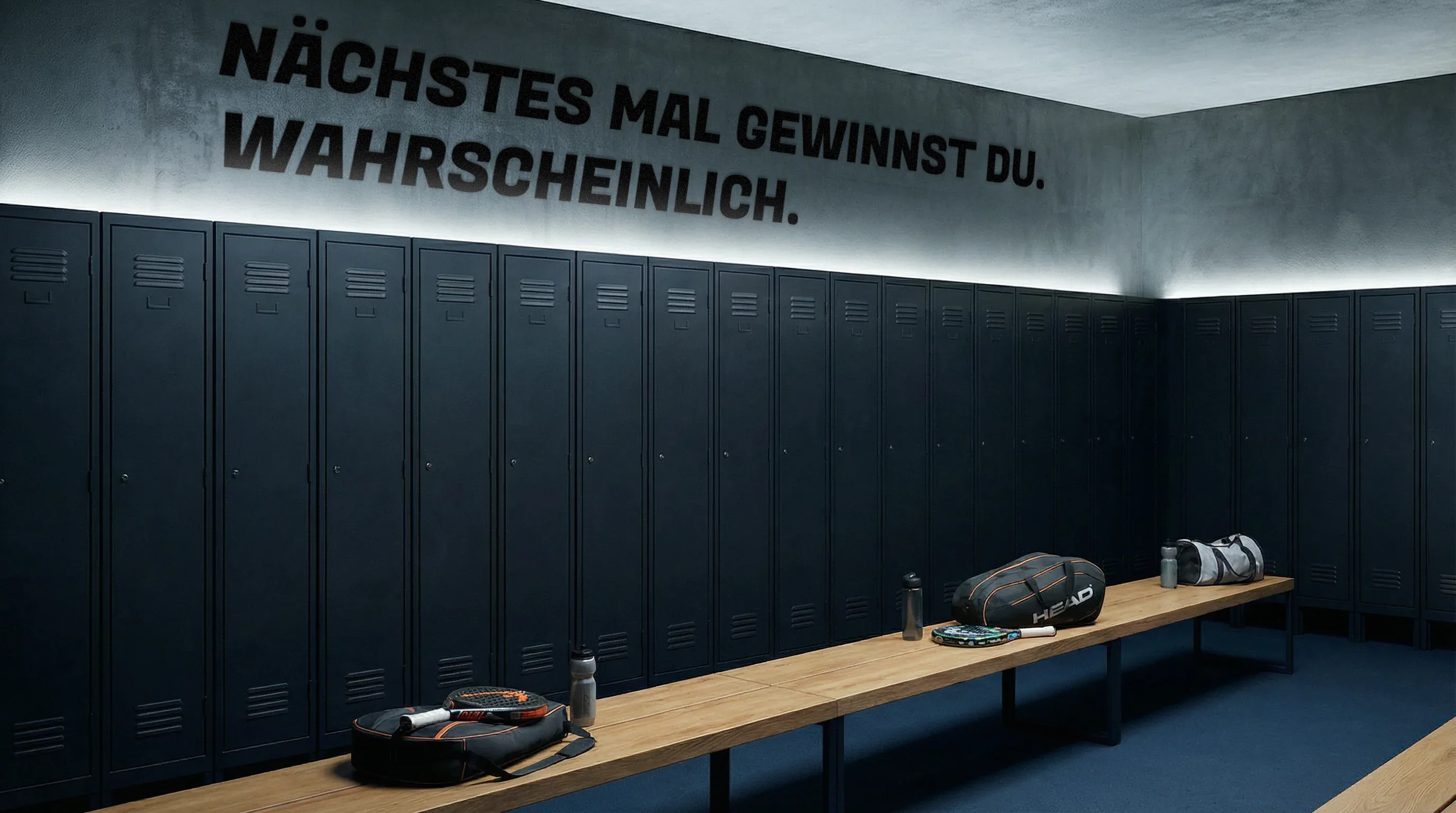
Only inside our own space, and only outside the camera axis. Changing room and lounge taglines stand alone, because the space is the brand. A carrier that can leave the space always needs a sender.
Camera axis: monogram below the claim
The court is glazed on all sides. A wall in its line of sight therefore sits in the background of almost every match photo, and the photo leaves the venue. There the claim carries the monogram below it, centred, roughly one cap height tall. Never the wordmark, it explains a sender that the space has already made clear.
04
Glass
Do
- At most one logo per glass wall.
- Always apply on the outside. On the inside the film changes ball rebound and breakage behaviour.
- White is standard, black the alternative.
- Place the logo in the lower part of the wall, not centred, not at the top.
- Leave the upper glass clear.
Don't
- No text on glass. Neither claim nor tagline nor URL. Applies to clear court glass. Shop windows: see Retail / Store. An opaque vinyl band is a carrier of its own (see Claim).
- No blue on glass.
- No film on the inside face.
- No one-way vision film.
- No co-branding with third-party marks on glass.
At most 30 % coverage per pane, measured as actually opaque area, not as bounding box. An outline logo counts only with its stroke width.
The exception: large outline monogram
The outline monogram may sit large and centred on the rear glass. This is deliberate and not a breach of the coverage rule: because only the stroke is opaque, sightlines stay practically unaffected and the surface remains fit for competition. A solid, large-area branding would not be possible in the same place. Execute as vinyl cut so it can be removed in under an hour for a tournament.
FIP tournament play
FIP Tour tournaments apply stricter limits: glass vinyls no higher than 35 cm from the floor, printed both sides, applied outside, background colour matching the wall. Always execute glass branding so it stays temporarily removable, vinyl cut rather than ceramic print.
05
In someone else's space
When a banner hangs in an external venue, the court explains the sport but not us. The surface stands alone, nobody sees two of them at once. That is why different rules apply than on our own court.
| Element | Rule |
|---|---|
| Sender | Mandatory, and it is the wordmark. The monogram assumes recognition that an external venue does not provide. |
| Message | Claim or tagline, never both. The ranking line “Germany’s number one padel shop” does not belong on a banner, there it reads as advertising rather than orientation. |
| Reference | A URL makes sense here, otherwise there is no route from the venue to the shop. |
| Accent line | Exactly one per visible surface. Where logo, claim and URL sit together, exactly one of them carries the line. |
| Colour | White on black. Blue only in the line, never as an area. |
| Ratio | The logo takes up at most half the banner width. |
Screens in a third-party venue
A display in a third-party space has no sender, unlike social video, where the profile picture identifies the sender. That is why the wordmark (or the partnership lockup) stays in one corner for the full running time, at minimum size (120 px wide), with at least 5 % margin to the frame edge. Motion rules: Retail / Store, motion on screens.
06
Legibility at distance
What a surface can carry depends on reading distance.
| Level | Distance | What the surface carries |
|---|---|---|
| Far | from 15 m | The mark only. No accent line, the surface stays black and white. |
| Mid | 4 to 15 m | Claim or headline. |
| Near | under 4 m | Tagline, detail, body copy. |
Rule of thumb from signage practice: cap height in centimetres times three gives the maximum reading distance in metres. All caps costs 10 to 20 % legibility against mixed case, factor that in. Below two metres, set in Fira Sans in normal case rather than Fugaz One.
Mandatory small print on large formats
Applies to mandatory notices on posters, banners, shop windows, court branding and POS: discount exclusions, asterisk explanations, terms of participation.
- At least 1/10 of the eye-catcher: the cap height of the mandatory notice is at least one tenth of the cap height of the main message.
- Roughly 3 mm cap height per metre of reading distance: a poster read from 3 m needs about 9 mm cap height in the mandatory notice.
- Never smaller than the other functional text on the same medium.
- Spatially next to the eye-catcher, so that message and restriction are read together.
- The real size counts: if it is not known, calculate it back from the finished layout and the final format, do not estimate it on screen.
- A footnote clarifies, it does not contradict: "ALL BRANDS" with an asterisk that excludes brands cannot be fixed, no matter how large the notice is. Then the main message has to change.
07
No-gos
- Blue glass film or blue boards
- Text on court glass (shop windows: see Retail / Store; an opaque vinyl band is a carrier of its own, see Claim)
- Film on the inside face of the glass
- Monogram used as a pattern or wallpaper
- The claim as a permanent floor marking
- A logo on the court floor, except as temporary event film
- The ranking line at the cage or on banners
- A statement with no sender in sight
- Freestyle copy without central approval